
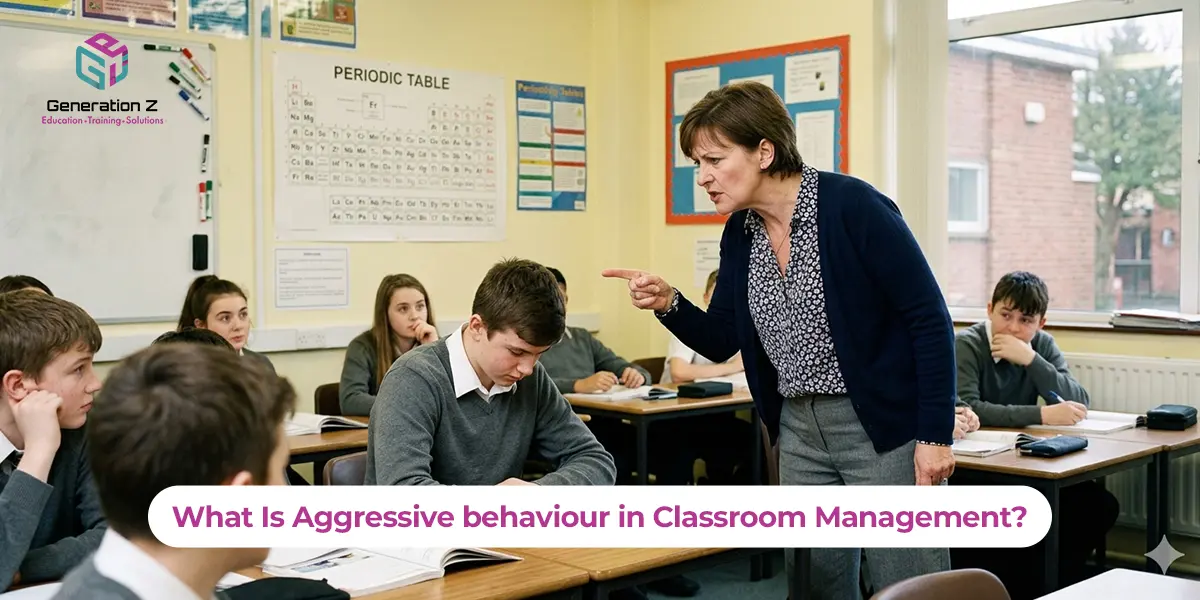
Some classes don’t go off track all at once. It’s slower than that. A comment here, a refusal there, a bit of friction that keeps building until the room feels different and heavier. You notice it but you also have a lesson to finish, so you move on. Later, it stays in your head longer than it should. That is when people start looking into something like a behavioural management course, not out of curiosity but because the same situations keep repeating.
What Aggressive Behaviour In Classroom Management Actually Looks Like Day To Day
Aggressive behaviour is often misunderstood as something loud or extreme. In reality, it shows up in ways that feel quite ordinary at first.
Aggressive Behaviour Is Not Always Loud
Yes, there are moments where a student raises their voice or argues openly. Those are easier to identify. But a lot of disruption is quieter. A student who keeps ignoring instructions. Someone who mutters under their breath every time they are corrected. A pattern of delaying work until it affects the flow of the whole class.
None of this looks dramatic on its own. Together, it changes the rhythm of the room.
Aggressive Behaviour Tends To Repeat
If you watch closely, most behaviours are not random. They follow a pattern. Some students react strongly when corrected in front of others while some struggle during transitions. Especially when moving from a free activity to structured work as well a few seem fine most of the time then suddenly react in a way that feels out of proportion.
It is easy to miss this at the moment. Later, when you think about it, the pattern becomes clearer.
Why Aggressive Behaviour In Classroom Management Happens More Often Than Expected
There is a tendency to look for one clear reason. Usually, there isn’t one.
Often Tied To Emotional Control
Not every student has the ability to manage frustration, especially in a busy classroom. A simple instruction can feel like pressure. A correction can feel like embarrassment. What comes out is not always planned. It is a reaction. Teachers see this often, even if it is not always discussed openly.
Aggressive behaviour in Classroom Management Is Shaped By The Environment
The classroom itself plays a role. A noisy setting, unclear instructions or sudden changes in routine can increase tension even seating arrangements can affect how students respond to each other. Over time, you start noticing that behaviour is not only about the student. It is also about what is happening around them.
At Generation Z Education, we have heard similar reflections from teachers who begin to connect these dots after some experience. It usually does not happen in one moment. It builds slowly.
How Responses Can Either Calm Or Escalate The Situation
This is where things become a bit uncomfortable, because response matters as much as behaviour.
Reacts To Tone More Than Words
What you say matters, but how you say it matters more. A sharp tone can escalate even a small issue. A calm, steady response often slows things down. Not always, but more often than expected. This is not about staying perfectly composed all the time. That is not realistic. It is about recognising how quickly tone shifts the situation.
Needs Consistency To Settle
Students notice patterns in teacher responses as well. If rules change depending on the day or mood, it creates confusion. That confusion sometimes turns into resistance. Simple consistency helps, same expectations with similar follow-through. Over time, it reduces pushback.
Many educators who go through some form of behaviour management training say this is where things start to feel slightly more in control. Not easy, but clearer.
Small Strategies That Make A Real Difference Over Time
There is no perfect approach. Most teachers try a mix of things and adjust as they go.
Improves When Addressed Early
Letting small issues pass can sometimes lead to bigger disruptions later. A quick and calm response in the moment often prevents escalation. It does not need to be dramatic; even a brief pause and redirection can work.
Aggressive Behaviour In Classroom Management Shifts With Positive Attention
Students respond to recognition even in small ways such as noticing when someone follows instructions, completes work or supports others can change the overall tone of the class. It creates a different kind of focus. It sounds simple, however in a busy classroom it is easy to forget.
Classroom Management Needs Clear Limits
Support and understanding do not replace boundaries. Students need to know what is acceptable and what is not. Consequences should be fair and consistent. Not harsh, not unpredictable. When limits are clear, there is less room for argument.
Where Structured Learning Fits Into All This
A lot of behaviour management is learned through experience. Trial, error, adjustment. Still, that process can feel slow. Sometimes confusing. That is where something like a behaviour management course starts to make sense. Not as a strict system, but as a way to organise what teachers are already experiencing in their classrooms.
At Generation Z Education, we often see educators who are not new to teaching. They come in with real situations, real frustrations and a need to understand why certain approaches work better than others. It becomes less about learning from scratch and more about making sense of patterns they have already noticed.
Final Thoughts
Aggressive behaviour does not fully disappear. Even in well-managed classrooms, there are difficult days. What changes is how those days feel. With time and some clarity, situations resolve faster. Reactions become less intense. The class returns to normal more quickly. And maybe that is what most teachers are actually looking for. Maybe not perfectly but a way to handle things without carrying the weight of every incident long after the class ends.
Because that part, the part you take home with you, tends to matter more than the moment itself.