Why Ajman Is the Next Hub for Education Investment in UAE
18 September 2026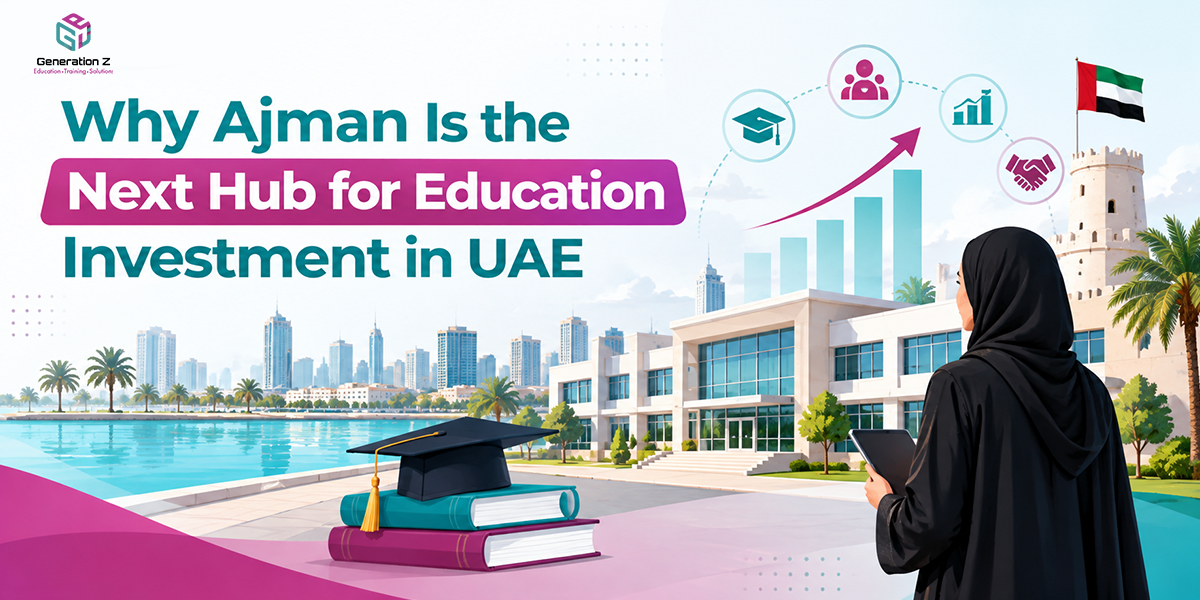
While investors compete for space in Dubai and Abu Dhabi, Ajman's growing family population and lower cost base are quietly building one of the UAE's most interesting early-mover opportunities.
Ajman has historically sat in the shadow of Dubai and Sharjah for education investment attention, but shifting demographics — driven largely by families priced out of neighbouring emirates' housing markets — are creating real, underserved demand for quality private schooling. For investors comfortable with an early-mover position, Ajman currently offers a combination of lower land costs, less saturated competition, and a rapidly growing addressable family population that's increasingly hard to find elsewhere in the UAE. This guide sets out what's actually driving the opportunity and what investors should plan for entering a genuinely emerging market.
Ajman's residential growth has been fuelled substantially by families seeking more affordable housing while still commuting into Dubai or Sharjah for work, which has steadily grown the emirate's school-age population faster than its private school capacity. Existing schools in several curriculum categories are already at or near capacity, with limited new supply in the pipeline.
This supply-demand gap is most pronounced in mid-market curriculum segments — British and Indian curriculum schools with moderate fee positioning — rather than the premium segment that dominates in Dubai, making Ajman a genuinely different investment thesis rather than a smaller copy of the Dubai market. Government investment in Ajman's residential and transport infrastructure has also continued steadily, supporting the case that current population growth reflects a durable trend rather than a temporary spillover from more expensive neighbouring emirates.
1. Fee Sensitivity and Positioning
Ajman's family demographic is generally more fee-sensitive than Dubai's, which means investment models built around Dubai's premium fee ceilings will overstate expected revenue — pricing needs to reflect the local market realistically.
2. Regulatory and Licensing Considerations
Ajman's private education regulatory landscape differs from KHDA, ADEK, and SPEA, and investors moving into the emirate for the first time need documentation built specifically for its requirements.
3. Site Selection in a Less Mature Market
With fewer established comparable schools nearby, site selection in Ajman benefits from a more rigorous independent demand assessment than a market like Dubai, where existing schools already validate an area's viability.
4. Building Brand Recognition From Scratch
Without an established local track record, a new school in Ajman needs a deliberate community engagement and reputation-building strategy from day one, since word-of-mouth in a smaller, less saturated market can either accelerate enrolment quickly or, if managed poorly, take considerably longer to build than in a more established market.
Unlike Dubai, where new entrants compete against dozens of established, well-rated schools, Ajman's relatively limited existing supply means an early, well-positioned school can capture a disproportionate share of local demand before competition intensifies — an advantage that tends to erode as more investors recognise the opportunity.
Being early doesn't mean rushing an underprepared launch — the advantage comes from being among the first genuinely well-run, properly compliant schools in the market, not simply the first school to open regardless of quality.
Ajman's opportunity is real, but it rewards investors who validate demand and pricing carefully rather than assuming a Dubai playbook transfers directly. Done right, this is exactly the kind of market where early movers build a durable competitive position.
As with any emerging market, the investors who do best tend to combine genuine local demand validation with the patience to build reputation properly, rather than expecting the same immediate brand recognition a well-known Dubai school might command.
Our Education Investment & Transaction Advisory service evaluates emerging markets like Ajman against real demographic and demand data, helping early-mover investors validate the opportunity before committing capital.
| Service | What We Do for You |
|---|---|
| Education Investment & Transaction Advisory | We evaluate emerging markets like Ajman against real demographic and demand data before you commit capital. |
| License Certification and Approval | We manage regulatory applications across all UAE emirates, including newer education markets. |
| School Site Inspections And Approval Services | We evaluate prospective sites against local regulatory and demand requirements before you sign. |
| Open School K-12 | We guide new school launches in emerging UAE markets from feasibility through opening. |
If this topic is relevant to your plans, the right next step is a conversation — not more research. Our team at Generation Z Education works with investors, institutions, educators, and families across the UAE to turn goals into outcomes.
Book Your Discovery Session
- Review Ajman’s demographic trends and school-age population growth
- Assess fee positioning and realistic revenue models for the local market
- Map regulatory and licensing requirements specific to Ajman
- Outline how our services support early-mover school launches from feasibility to opening
Generation Z Education is a KHDA-permitted education consultancy based in Dubai, supporting investors, institutions, educators, and families across the UAE. With over 20 years of combined expertise, they guide clients from strategy to execution covering licensing, school setup, staff training, and quality assurance.