Step-by-Step School Licensing Process in UAE: KHDA Edition
01 July 2026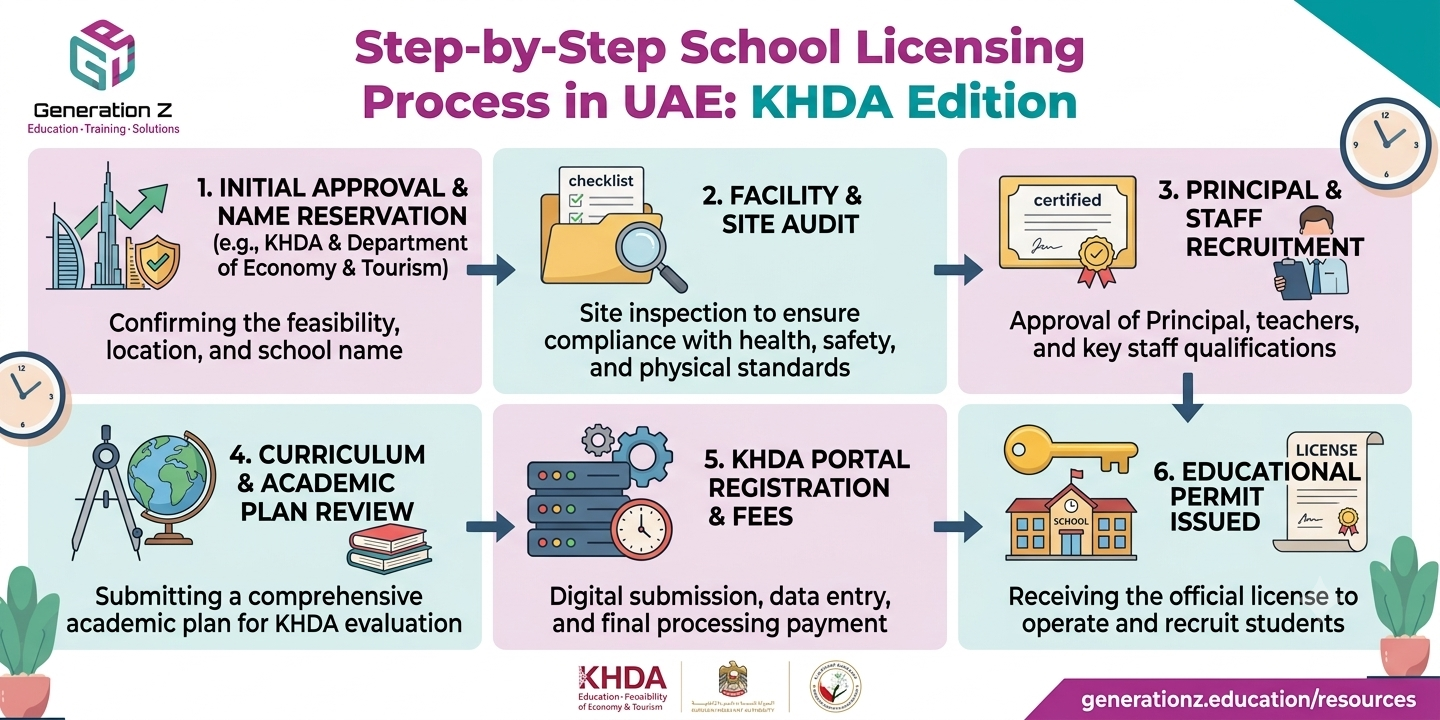
A school license in Dubai isn't a single approval — it's a sequence of dependent steps, and getting the order wrong can cost investors months.
Opening a private school in Dubai under KHDA requires navigating a structured, multi-stage licensing process that touches land use, curriculum approval, staffing, and facility compliance — each with its own documentation and its own regulator sign-off. Investors who treat licensing as a single application often discover, midway through, that a step they assumed was optional was actually a prerequisite for the next one. This guide walks through the sequence KHDA actually expects, where the process most commonly stalls, and how experienced operators sequence their decisions to avoid losing months to avoidable resubmission.
KHDA licensing broadly moves through initial approval-in-principle, site and facility inspection, curriculum and staffing submission, and final operating license issuance. Each stage requires documentation that builds on the previous one — for example, facility approval typically must be secured before KHDA will review your staffing and curriculum plan in detail, since classroom capacity determines permitted enrolment numbers.
Investors frequently underestimate how much the facility stage shapes everything downstream. KHDA's space and safety requirements are specific — classroom sizes, outdoor space ratios, and safety infrastructure all have defined minimums — and a site that looked adequate on paper can fail inspection, forcing a costly redesign after the lease is already signed. This is compounded when investors negotiate lease terms based on a general sense of the space needed, rather than the specific, documented ratios KHDA will actually apply during facility inspection.
1. Curriculum and Accreditation Documentation
Curriculum submissions need to demonstrate alignment with both the chosen international framework and UAE national identity requirements, including Arabic and Islamic/moral education provision. Incomplete curriculum mapping is one of the most common reasons for resubmission, and investors working from a curriculum plan built for a different country's market often need substantial rework before it satisfies KHDA's specific documentation format.
2. Staffing and Qualification Verification
KHDA requires verified qualifications and, in many cases, local equivalency checks for teaching staff before a license is finalised — recruiting before this is confirmed often results in staff who can't legally be counted toward your approved teaching roster.
3. Fit-Out and Compliance Design
Interior design and fit-out decisions made without KHDA's inspection criteria in mind often need costly rework once inspectors flag non-compliant classroom layouts, signage, or safety installations. This is one of the most expensive stages to correct retroactively, since it typically involves physical construction changes rather than simple documentation edits.
4. Final Operating License Timing
Investors sometimes assume the final operating license is a formality once earlier stages clear, but it requires its own dedicated review window, and scheduling a launch date without buffer for this final stage is a common source of last-minute stress, even for otherwise well-prepared applications.
Investors who build their overall project timeline around KHDA's actual review sequence, rather than an assumed generic timeline, consistently launch closer to their original target date. This means treating facility, curriculum, and staffing as dependent stages with realistic review windows between them, not parallel workstreams that can simply be rushed at the end.
Building in Realistic Review Windows
Each submission stage carries its own KHDA review period, and stacking these realistically — rather than assuming instant turnaround — produces a launch timeline investors can actually hold their construction, staffing, and marketing plans against.
Securing the initial license is a milestone, not a finish line — KHDA continues to monitor compliance through the school's first inspection cycle and beyond, and the systems and documentation habits built during licensing directly shape how smoothly that first inspection goes.
Carrying Licensing Discipline Into Operations
Schools that treat licensing documentation as a one-time hurdle, rather than the foundation of an ongoing compliance system, often find themselves rebuilding records from scratch ahead of their first inspection — a preventable cost for an operator that already did the work once.
Renewal Cycles Require the Same Rigor
License renewal isn't automatic, and operators who let compliance documentation lapse after opening often find renewal far more burdensome than it needs to be, effectively repeating the original licensing effort under greater time pressure.
Learning From the First Inspection to Improve the Second
Even a well-prepared school rarely achieves a perfect first inspection, and the operators who improve fastest are the ones who treat the first cycle's findings as direct input into the following year's operational priorities, rather than filing the report away until the next visit approaches.
The investors who move through KHDA licensing fastest are the ones who sequence every decision — site, design, curriculum, staffing — against the regulator's actual review order, rather than working in parallel and hoping the pieces fit together at the end.
This discipline pays off well beyond the initial launch, too: a school built on properly sequenced, well-documented licensing tends to face far fewer complications at subsequent inspection cycles, since the compliance foundation was built correctly from day one rather than patched together under time pressure.
Our License Certification & Approval service manages your full application sequence across all authorities — documented precisely and followed up with KHDA directly, so no stage stalls waiting on missing paperwork.
| Service | What We Do for You |
|---|---|
| License Certification and Approval | We manage your full KHDA application process — sequenced correctly, documented precisely, and followed up rigorously. |
| School Site Inspections And Approval Services | We evaluate prospective sites against KHDA compliance standards before you sign a lease. |
| Compliant Learning Space Design with Regulatory Bodies | We integrate KHDA facility requirements into your fit-out design from the earliest stage. |
| Education Investment & Transaction Advisory | We help you model the financials and sequence capital deployment around the licensing timeline. |
If this topic is relevant to your plans, the right next step is a conversation — not more research. Our team at Generation Z Education works with investors, institutions, educators, and families across the UAE to turn goals into outcomes.
Book Your Discovery Session
- Review your investment intent, location thinking, and timeline
- Identify the specific risks in your current plan
- Map the approvals process to your exact scenario
- Outline how and where our services protect and accelerate your project
Generation Z Education is a KHDA-permitted education consultancy based in Dubai, supporting investors, institutions, educators, and families across the UAE. With over 20 years of combined expertise, they guide clients from strategy to execution covering licensing, school setup, staff training, and quality assurance.