Before & After: How We Improved a Dubai School's KHDA Rating
24 September 2026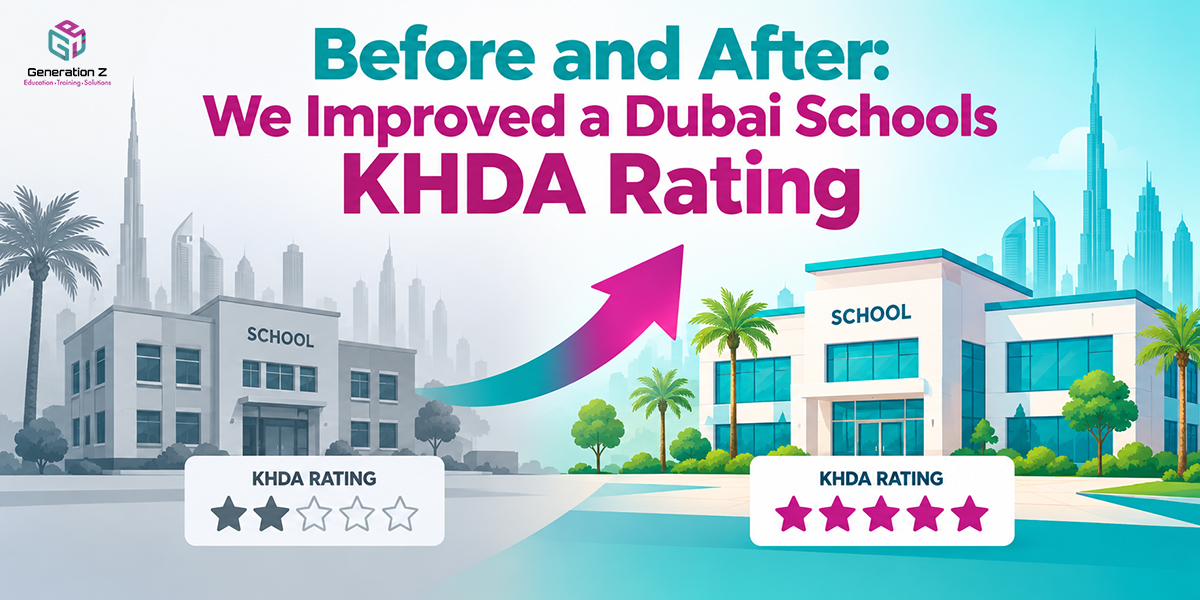
A school stuck at “Acceptable” for three consecutive inspection cycles brought us in to find out why — and to fix it before the next visit.
A well-established Dubai school approached Generation Z Education after receiving an “Acceptable” KHDA rating for the third consecutive inspection cycle, despite genuine investment in facilities and staff. The leadership team suspected something structural was holding the rating back but couldn't pinpoint what, since day-to-day classroom observation looked broadly positive. The gap, once identified, turned out to be less about teaching quality and more about how progress was being tracked, documented, and demonstrated to inspectors — a finding that reshaped how the school approached its next full inspection cycle.
A structural audit revealed that while classroom teaching was genuinely solid, the school's systems for tracking individual student progress over time were inconsistent across departments, making it difficult for inspectors to see clear, sustained academic improvement — a key driver of the higher rating bands.
The school's technology integration also looked impressive on a walkthrough — smart boards and tablets were present in every classroom — but inspectors noted a lack of evidence that this investment was translating into measurably better learning outcomes, exactly the kind of surface-versus-substance gap inspection frameworks are designed to catch. This pattern is more common than school leadership teams often realise: strong, genuine classroom practice undermined not by teaching quality but by an inability to prove that quality consistently and systematically across the whole institution.
1. Standardising Progress Tracking Across Departments
A unified, school-wide system for tracking and documenting individual student progress replaced the inconsistent department-by-department approach, giving inspectors clear, comparable evidence of academic growth over time.
2. Reframing Technology Around Measurable Outcomes
Rather than adding more technology, the school restructured how existing tools were used, tying each digital tool explicitly to a specific learning objective and outcome measure inspectors could evaluate directly.
3. Structured Staff Training on Evidence Documentation
Teaching staff received targeted training not on teaching itself, but on how to document and evidence the strong practice already happening in their classrooms in a way inspectors could clearly assess.
4. Leadership Walkthroughs Focused on Evidence, Not Just Observation
Senior leadership shifted their own internal classroom walkthroughs to focus specifically on whether evidence trails existed for the practice they observed, catching documentation gaps months before the actual inspection rather than discovering them on the day.
A rating improvement that isn't sustained is only a temporary win, so as much attention went into building durable habits as into the initial fix — ensuring the new tracking and documentation systems would continue functioning well after the immediate inspection pressure had passed.
The new systems were built directly into the school's regular termly review calendar, rather than existing as a separate compliance exercise bolted on alongside normal operations, which made the improved practice self-sustaining rather than dependent on renewed effort each inspection cycle.
At the school's next inspection cycle, its rating moved up a full band — not because teaching quality changed dramatically, but because the school finally had the systems in place to demonstrate the quality that was already there. The case is a reminder that inspection ratings often reflect documentation and systems as much as classroom practice itself.
Perhaps more importantly, school leadership reported that the new systems also made their own internal understanding of student progress significantly clearer — a benefit that extended well beyond the inspection rating itself.
Our School Improvement Service builds continuous monitoring directly into a school's existing operational calendar, so improvement becomes routine rather than a periodic scramble.
| Service | What We Do for You |
|---|---|
| School Improvement Service | We implement continuous monitoring and quality assurance systems that keep schools inspection-ready year-round. |
| Educational Advisory Services | We assess curriculum and technology integration against KHDA's specific inspection framework. |
| Continuous Professional Development | We train staff on how to document and evidence strong classroom practice for inspectors. |
| License Certification and Approval | We support schools through the full inspection and licensing renewal process. |
If this topic is relevant to your plans, the right next step is a conversation — not more research. Our team at Generation Z Education works with investors, institutions, educators, and families across the UAE to turn goals into outcomes.
Book Your Discovery Session
- Review your current KHDA rating and inspection feedback
- Identify documentation and progress-tracking gaps
- Map a clear improvement plan aligned to the next inspection cycle
- Outline how our services support sustained rating improvement year-round
Generation Z Education is a KHDA-permitted education consultancy based in Dubai, supporting investors, institutions, educators, and families across the UAE. With over 20 years of combined expertise, they guide clients from strategy to execution covering licensing, school setup, staff training, and quality assurance.