Will AI Replace Teachers in UAE? What the Research Actually Says
13 November 2026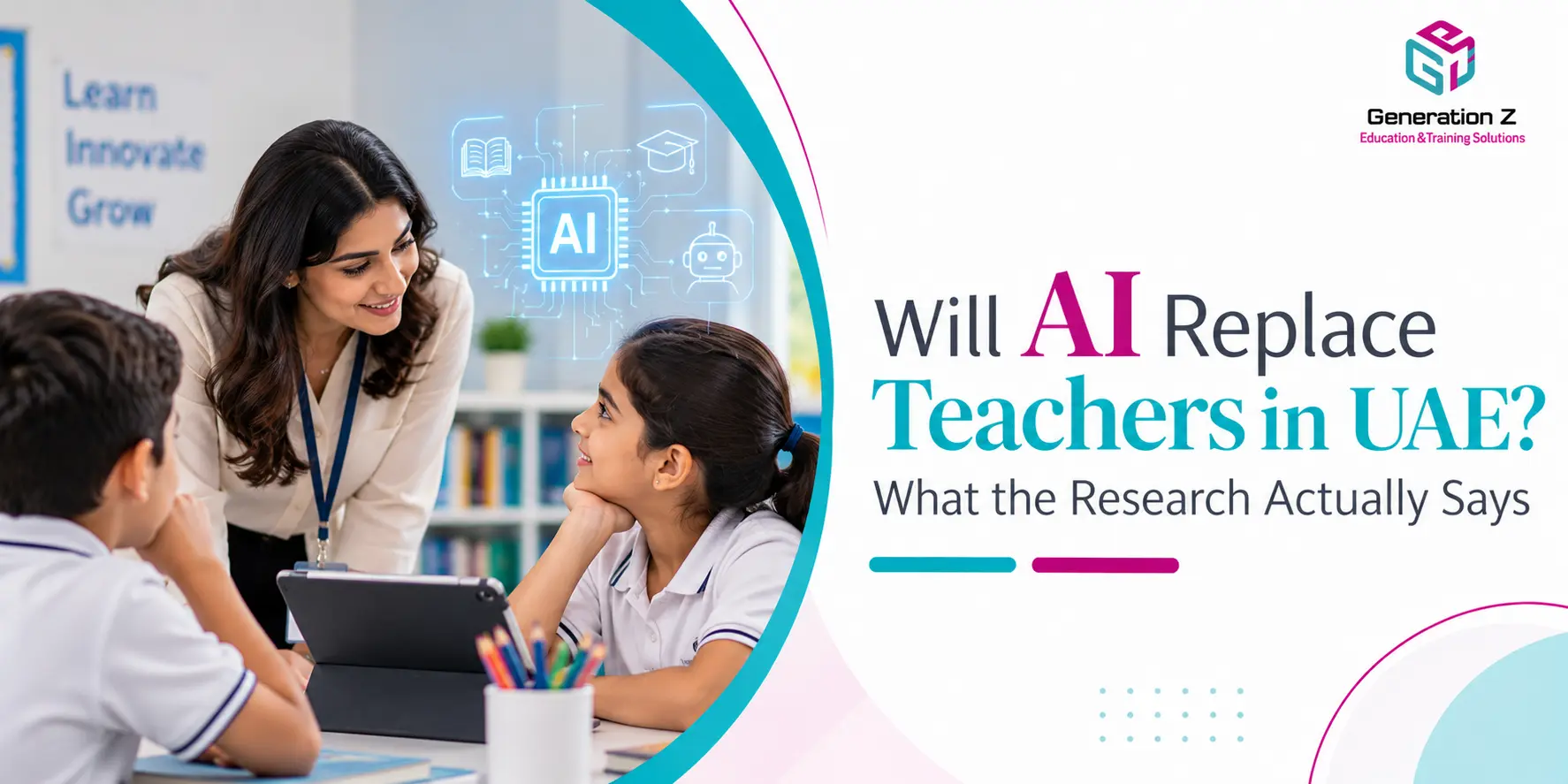
The honest answer is more nuanced than either the doom headlines or the dismissive reassurances suggest — and it matters for how schools plan staffing and training today.
As AI tools become more capable and more embedded in classroom technology, the question of whether they'll eventually replace teachers comes up regularly among parents, educators, and school leaders in the UAE. The available research and current trajectory of AI capability point toward a more nuanced answer than either extreme: AI is genuinely reshaping parts of the teaching role, but the evidence strongly suggests augmentation rather than replacement, at least for the elements of teaching that matter most for student outcomes. This guide sets out what the research actually supports, and what it means for how schools should be planning right now.
AI tools are demonstrably effective at handling specific, well-defined tasks — generating practice materials, providing instant feedback on routine assessments, personalising practice pacing — freeing teacher time that was previously spent on administrative and repetitive tasks.
What the research consistently shows AI struggling to replicate is the relational and motivational core of teaching — building genuine trust with a struggling student, reading subtle emotional and social cues, and providing the kind of encouragement that genuinely shifts a child's confidence and engagement, none of which current AI systems approximate convincingly. Studies examining student outcomes specifically also continue to find that the strength of the student-teacher relationship remains one of the most consistent predictors of academic and social-emotional success, a factor no current AI system has demonstrated the ability to replicate at scale.
Our Educational Advisory Services help schools distinguish where AI genuinely adds value in the classroom from where it risks displacing the human relationship that actually drives learning outcomes.
1. Reskilling Around AI-Augmented Teaching
Rather than fearing displacement, teachers benefit from developing skills specifically in how to use AI tools to free up more time for the relational and higher-order thinking work that remains distinctly human.
2. Redefining What “Good Teaching” Looks Like
As routine tasks increasingly shift to AI tools, schools' definitions of strong teaching are evolving to emphasise mentorship, emotional intelligence, and complex problem-solving facilitation even more heavily than before.
Our Continuous Professional Development programmes help teachers build exactly these augmented skills, positioning them to work alongside AI tools rather than compete with them.
3. Maintaining the Human Core of Education
Schools that thoughtfully integrate AI while deliberately protecting time and space for genuine teacher-student relationship building are likely to see the strongest outcomes, both academically and for student wellbeing.
4. Being Honest With Staff About the Trajectory
Schools that communicate openly and honestly with staff about how AI is likely to reshape — rather than eliminate — teaching roles tend to see far less anxiety and resistance among staff than schools that avoid the conversation entirely, leaving teachers to draw their own, often more alarming, conclusions.
While AI capability continues to advance quickly, the practical, responsible integration of these tools into genuine classroom practice tends to move considerably more slowly, shaped by regulatory caution, data privacy considerations, and the simple reality that pedagogical change takes time to embed well.
Schools that plan for a gradual, multi-year evolution in how AI is used — rather than either ignoring it or overreacting to worst-case predictions — are best positioned to adapt thoughtfully as the technology and the regulatory environment around it continue to mature together.
Our School Improvement Service helps schools build a realistic, phased roadmap for AI integration, avoiding both premature overreaction and complacent inaction.
The evidence strongly suggests AI will keep reshaping what teaching involves, but the human relationship at the centre of genuine learning remains difficult, and likely impossible, for current AI to replicate. Schools that prepare their staff accordingly will be best positioned for what comes next.
As this evolution continues, the schools and educators who thrive will be those who lean into what makes human teaching irreplaceable, rather than those who treat AI purely as a threat to be resisted.
| Service | What We Do for You |
|---|---|
| Educational Advisory Services | We help schools distinguish where AI genuinely adds classroom value from where it risks displacing human connection. |
| Continuous Professional Development | We help teachers build the augmented skills needed to work effectively alongside AI tools. |
| Emotional Intelligence for Leaders | We help school leaders protect and prioritise the human, relational core of education. |
| School Improvement Service | We help schools build thoughtful, outcome-focused AI integration strategies. |
If this topic is relevant to your plans, the right next step is a conversation — not more research. Our team at Generation Z Education works with investors, institutions, educators, and families across the UAE to turn goals into outcomes.
Book Your Discovery Session
- Review your investment intent, location thinking, and timeline
- Identify the specific risks in your current plan
- Map the approvals process to your exact scenario
- Outline how and where our services protect and accelerate your project
Generation Z Education is a KHDA-permitted education consultancy based in Dubai, supporting investors, institutions, educators, and families across the UAE. With over 20 years of combined expertise, they guide clients from strategy to execution covering licensing, school setup, staff training, and quality assurance.